Low Dimensional Motor Skill Learning Using Coactivation
A deep RL framework that learns high-fidelity motor skills by controlling a humanoid through a low-dimensional joint “coactivation” (synergy) space extracted from reference motion — reducing action dimensionality while remaining robust even under sparse rewards.
Highlights Video
Conference Presentation
Overview
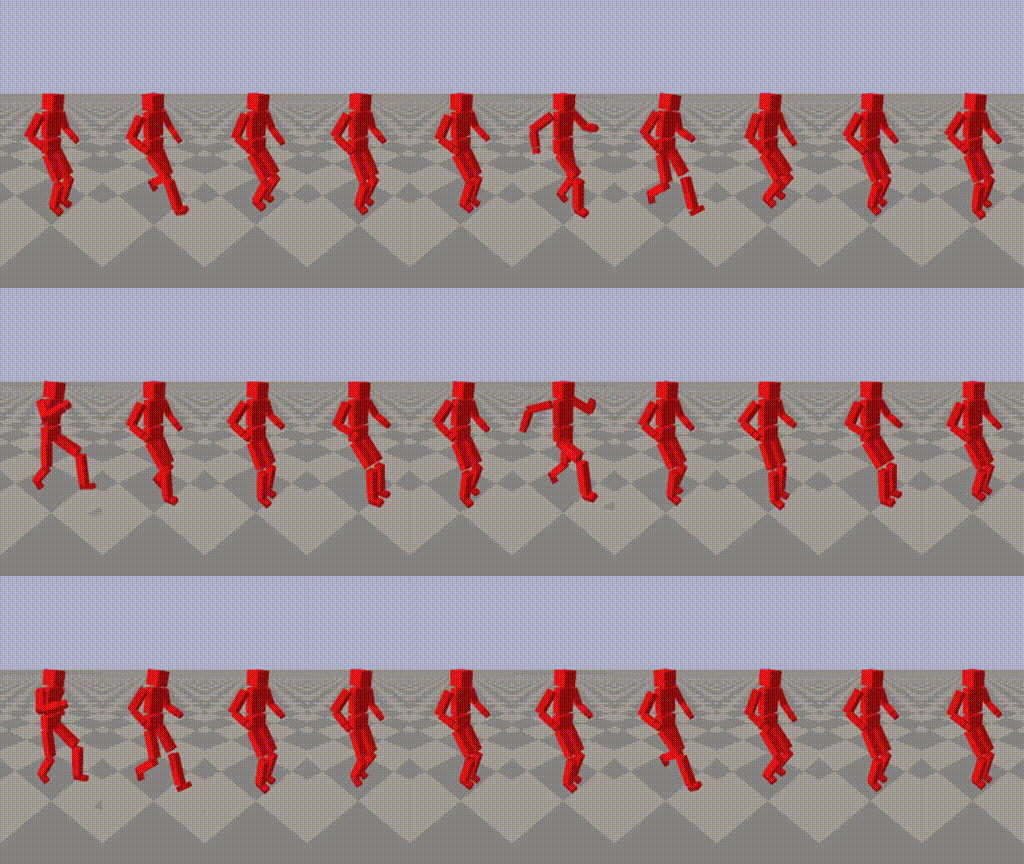
We propose an approach for motor skill learning of highly articulated characters based on the systematic exploration of low-dimensional joint coactivation spaces. Through analyzing human motion, we first show that the dimensionality of many motion tasks is much smaller than the full degrees of freedom (DOFs) of the character. Indeed, joint motion appears organized across DOFs, with multiple joints moving together and working in synchrony. We exploit such redundancy for character control by extracting task-specific joint coactivations from human recorded motion, capturing synchronized patterns of simultaneous joint movements that effectively reduce the control space across DOFs. By learning how to excite such coactivations using deep reinforcement learning, we are able to train humanlike controllers using only a small number of dimensions. We demonstrate our approach on a range of motor tasks and show its flexibility against a variety of reward functions, from minimalistic rewards that simply follow the center-of-mass of a reference trajectory to carefully shaped ones that fully track reference characters. In all cases, by learning a 10-dimensional controller on a full 28 DOF character, we reproduce high-fidelity locomotion even in the presence of sparse reward functions.
Key Results
- Shows empirically that many motor tasks have much lower intrinsic dimensionality than the character’s full DOFs (e.g., few principal components reconstruct motion well).
- Introduces joint coactivations as a latent action space where each control dimension drives coordinated motion across many joints simultaneously.
- Provides a practical method to extract task-specific coactivation bases from motion capture (PCA/ICA), then keep the basis fixed during learning.
- Trains PPO policies to excite coactivations (rather than per-joint targets), achieving comparable or better motion quality with ~5–10D control on a 28-DOF character.
- Demonstrates improved reward robustness: Coactivation control can learn humanlike locomotion with reduced reward shaping (end-effector/COM tracking), where independent-joint baselines often fail or exploit rewards.
Publication
A. Ranganath, P. Xu, I. Karamouzas, and V. Zordan, "Low Dimensional Motor Skill Learning Using Coactivation", in Motion, Interaction and Games, 2019, Newcastle, UK, Oct 2019.
Download PDF