Digital Hormone based Distributed Controller for Multicellular Robotic Organisms
A distributed control framework for modular robotic organisms, where locomotion and obstacle avoidance emerge from local communication, topology-aware module behavior, and Digital Hormone–style message diffusion across self-reconfigurable robot configurations.
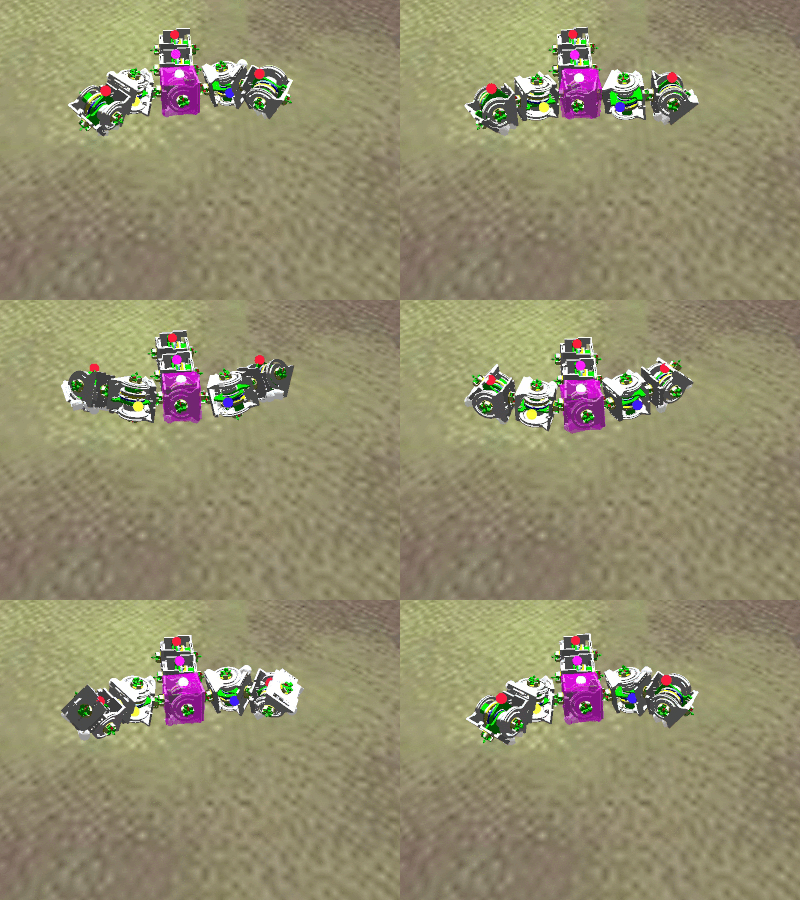
Highlights Video
Overview
This project explores distributed control for modular robots that can form different multi-cellular organisms. Instead of relying on a central controller, each identical module determines its local action from topology information, sensor state, and locally diffused “digital hormone” messages. The framework was implemented in simulation and validated across three robotic morphologies—caterpillar, V-shaped, and scorpion—demonstrating coordinated locomotion, obstacle avoidance, and partial fault tolerance when modules disconnect or fail.
Key Features
- Developed a distributed Digital Hormone Method control framework where global robot behavior emerges from local module-level decisions.
- Implemented dynamic topology mapping so each module can infer its role from local and multi-hop connection information.
- Designed reusable locomotion controllers for caterpillar, V-shaped, and scorpion modular robot configurations.
- Built distributed obstacle avoidance behaviors using local IR sensing and hormone diffusion rather than centralized planning.
- Demonstrated fault-tolerant behavior where disconnected caterpillar/V configurations can continue operating as smaller independent organisms.
Master Thesis
A. Ranganath, "Distributed Control Algorithm for a Multi Cellular Robot", Masters thesis, School of Informatics, University of Edinburgh, August 2009.
Download PDFProject: Part of the Symbrion project funded by the European Commission.